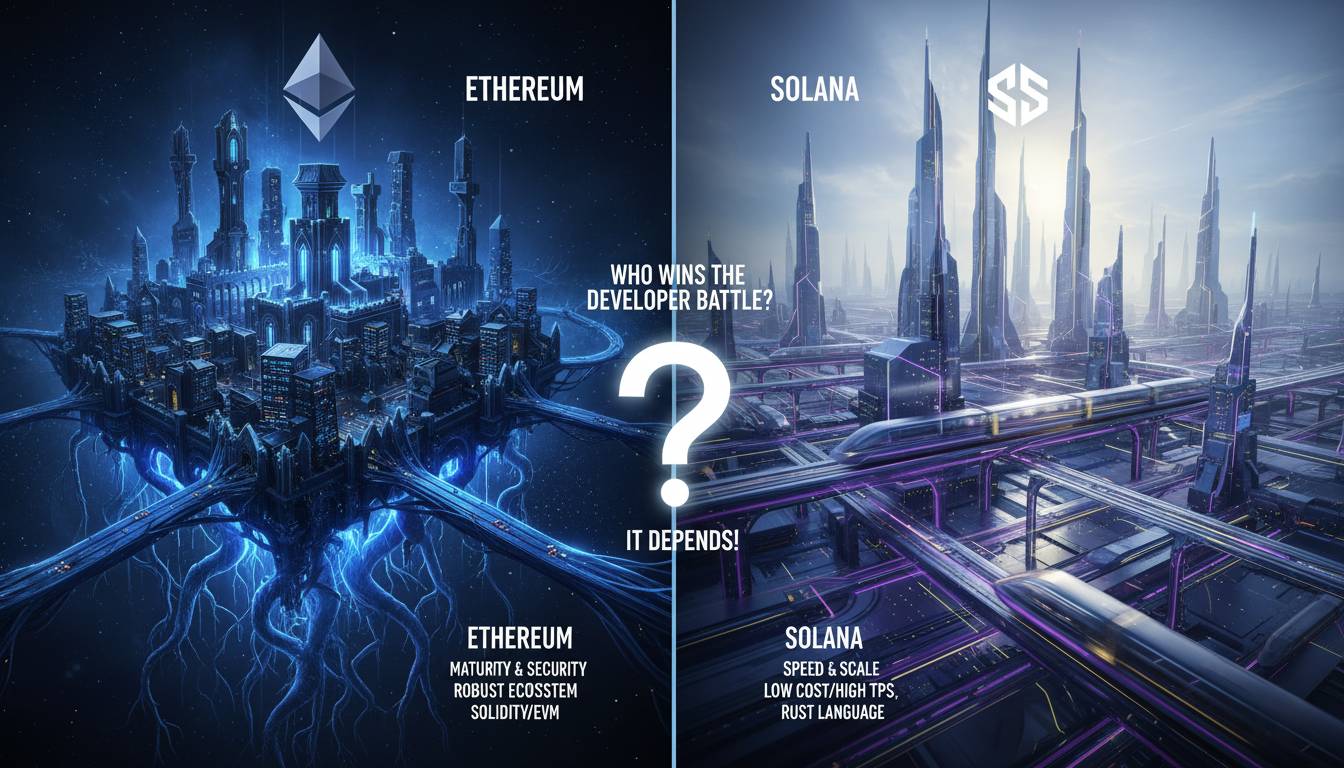
The developer battle between Solana and Ethereum isn’t a hypothetical anymore. It’s happening right now, and the numbers tell a more complicated story than either side wants to admit. Ethereum has network effects, mindshare, and nearly a decade of institutional adoption behind it. Solana has raw technical performance that makes developers who discover it genuinely excited. But here’s what surface-level comparisons miss: developer adoption isn’t just about how fast a chain can process transactions or how low its fees are. It’s about building a business case, finding talent, and betting on a platform’s long-term survival.
I’ve spent years watching this rivalry play out in Discord servers, GitHub repositories, and at conferences where the tribalism gets almost physical. What follows isn’t the sanitized comparison you’ll find on either project’s official website. It’s what the data actually shows, where both chains have genuine advantages, and why the “winner” depends entirely on what you’re building.
Developer counts
Both projects pour enormous resources into looking dominant on this metric. The most recent reliable data comes from Electric Capital’s annual developer report, which tracks monthly active developers across blockchain ecosystems. As of late 2024, Ethereum had roughly 3,000-4,000 monthly active developers across its ecosystem—a number that has remained relatively stable despite competitor chains’ aggressive growth campaigns.
Solana’s developer community tells a different story. The same data showed Solana hovering around 1,500-2,000 monthly active developers. But there’s a nuance that gets lost in headlines: Solana’s developer count grew faster percentage-wise in 2023-2024 than Ethereum’s did, even as the broader crypto market remained in a downturn. This suggests a genuinely motivated community building on the platform rather than developers following funding dollars.
Raw developer counts obscure a critical distinction, though. Ethereum’s developer ecosystem includes a massive layer of infrastructure teams building tooling, layer-2 solutions, and cross-chain bridges who aren’t building directly on Ethereum itself but serve the ecosystem. Solana’s numbers are more concentrated in direct application development. Depending on what you’re measuring, either chain could “win” this metric—which is why neither project can claim definitive superiority here.
The honest answer: Ethereum has more developers building more diverse infrastructure, but Solana’s developer community is more concentrated and arguably more active per capita.
Performance
This is where Solana typically makes its strongest pitch, and it’s not wrong. Solana’s theoretical throughput hits around 65,000 transactions per second under ideal conditions, compared to Ethereum’s roughly 15-30 transactions per second on the mainnet. Even after Ethereum’s Dencun upgrade in March 2024 introduced proto-danksharding to reduce layer-2 data costs, the performance gap remains substantial.
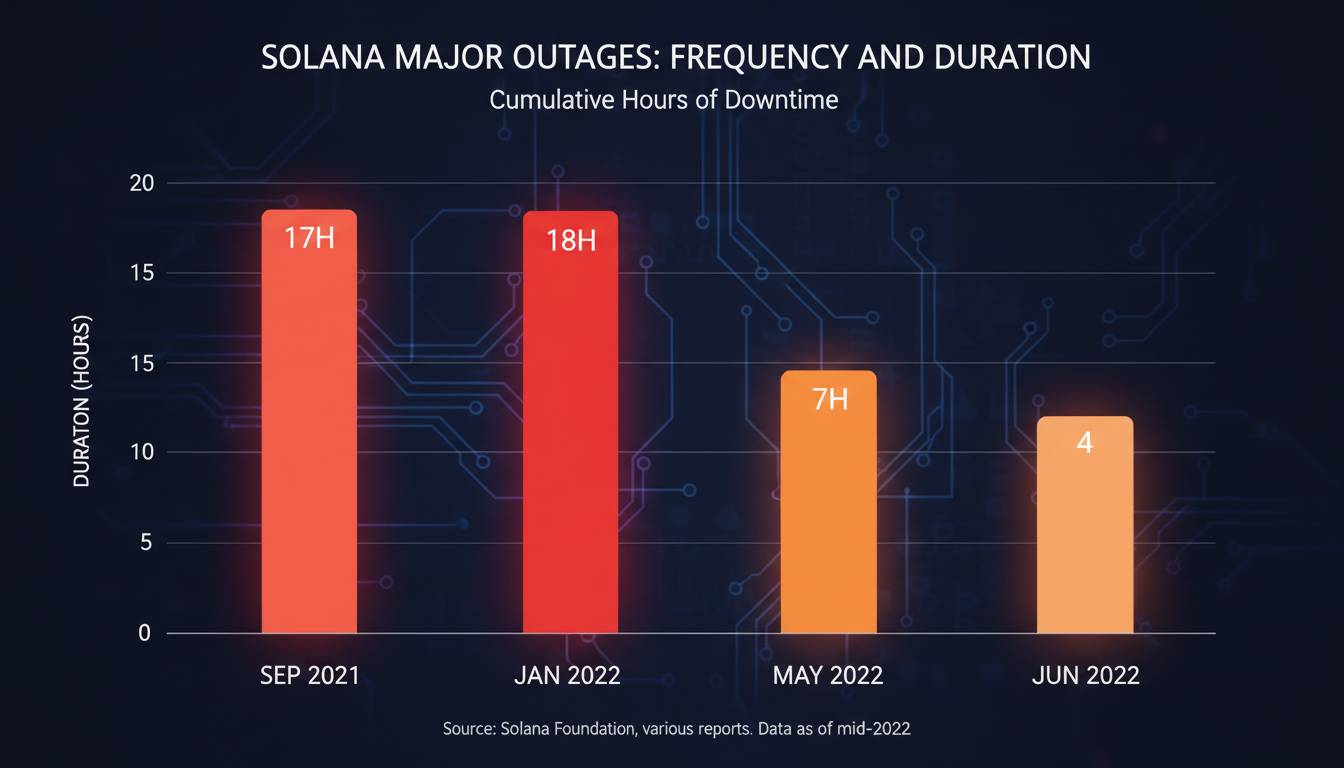
But there’s a catch: those TPS numbers assume ideal network conditions and no congestion. During actual high-demand periods—like the congestion crisis Solana experienced in 2022 and several smaller incidents since—performance degrades significantly. The network has improved its congestion handling since then, but the historical reliability issues created real trust problems with developers building production applications.
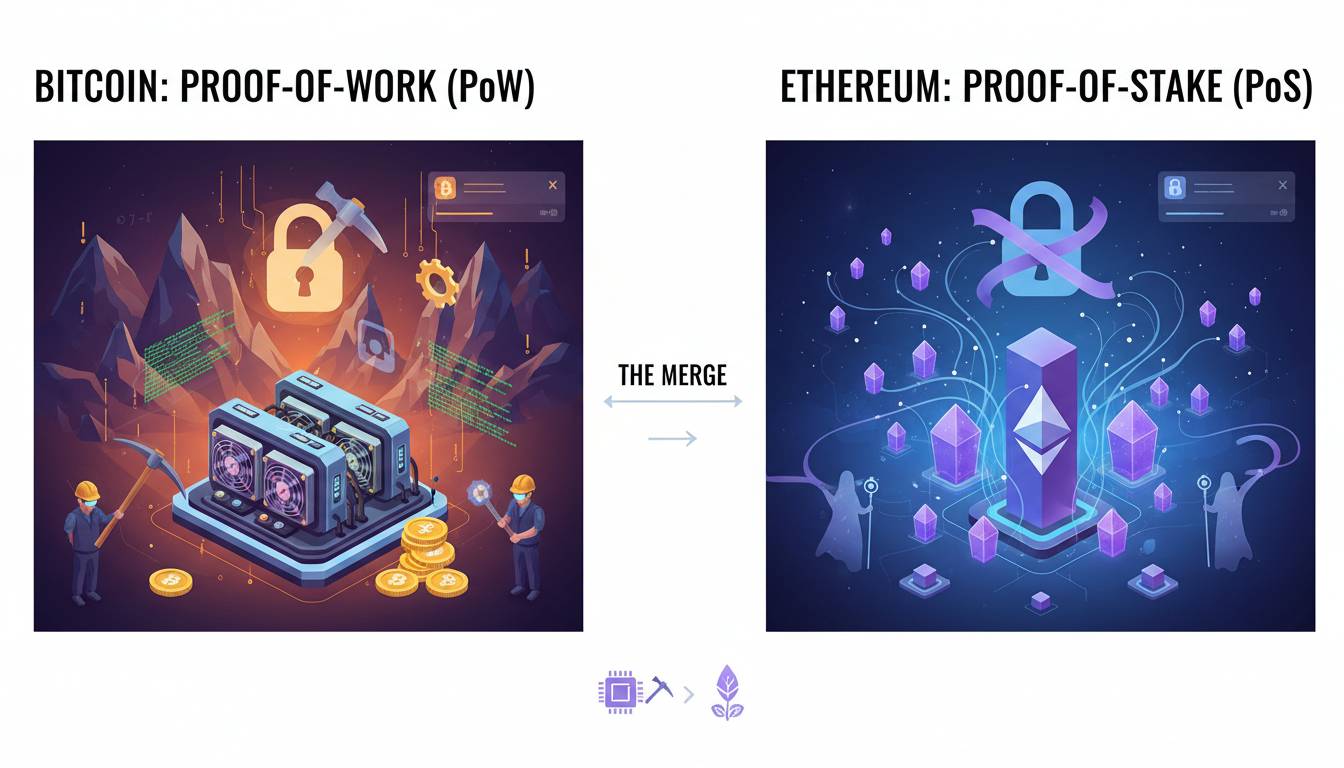
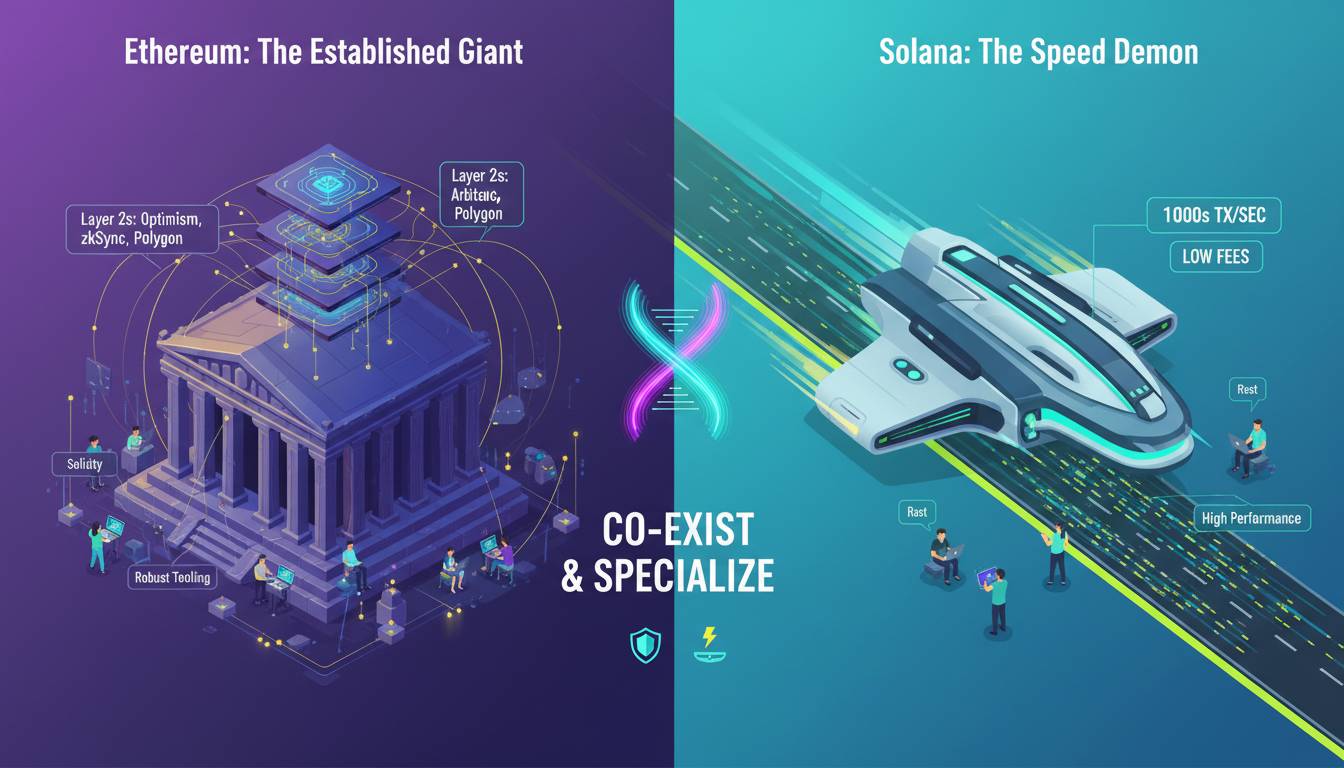
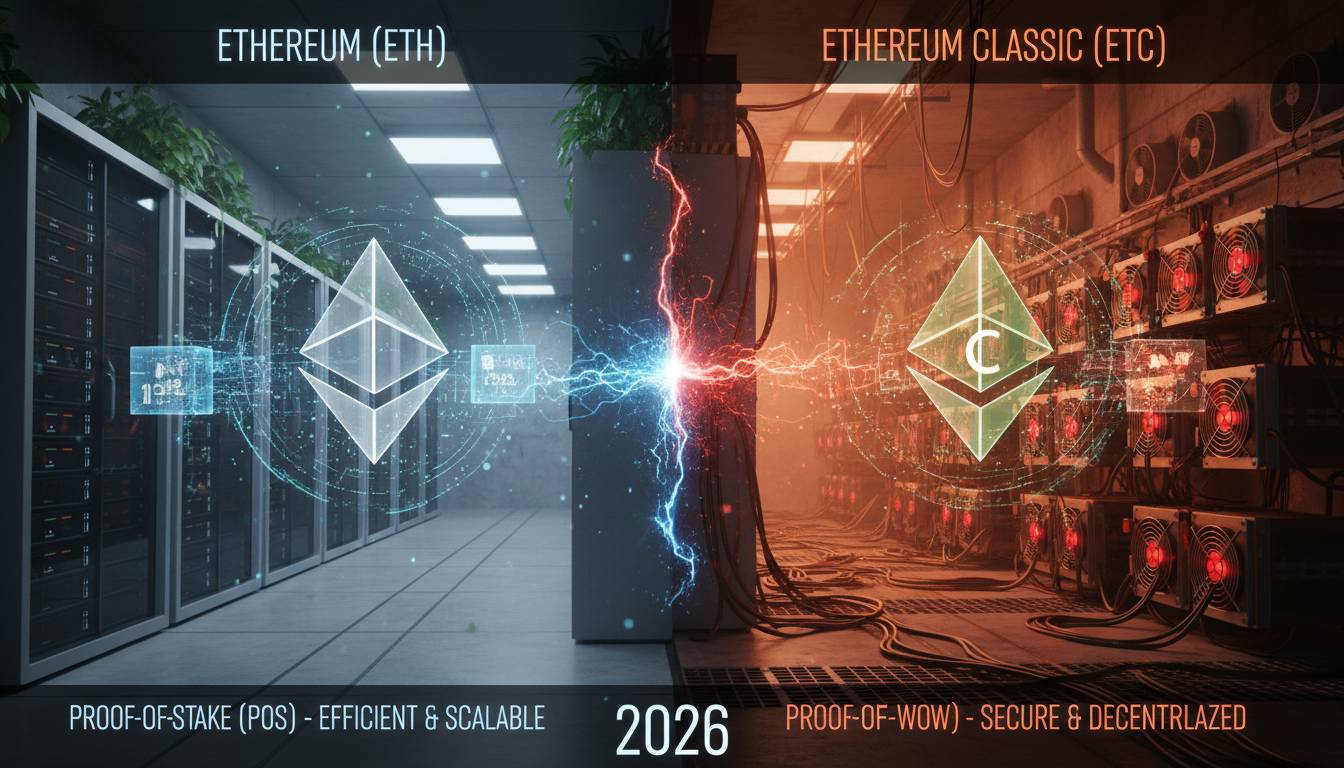
Ethereum’s approach has been more conservative but more predictable. The transition to proof-of-stake in September 2022 (The Merge) already reduced energy consumption by over 99%, and subsequent upgrades have steadily improved throughput. More importantly, Ethereum’s layer-2 ecosystem—Arbitrum, Optimism, Base, zkSync—has created a rollup-centric scaling strategy that many developers argue provides the best of both worlds: Ethereum’s security and ecosystem combined with transaction costs and speeds that compete with Solana for most practical applications.
Finality times tell a similar story. Solana achieves finality in around 400 milliseconds under normal conditions—genuinely impressive and significantly faster than Ethereum’s 12-15 minutes for full finality on layer-1. But Ethereum’s finality is more conceptually rigorous, with economic finality that makes reversion practically impossible. For many applications, Ethereum’s predictability matters more than Solana’s speed.
Programming languages
The language choice is where this battle gets interesting, because it determines not just what you build today but what your team looks like tomorrow.
Solana uses Rust as its primary programming language, along with slightly more accessible options like Solana’s own Anchor framework that simplifies development. Rust’s reputation for memory safety and performance is well-earned, and it’s become arguably the most respected systems programming language in the industry. Major companies beyond crypto—Discord, Dropbox, Cloudflare—use Rust in production. This means hiring talented Rust developers is possible even outside crypto, and those developers tend to be strong engineers.
Ethereum’s Solidity exists primarily within the blockchain ecosystem. It’s not a bad language—it’s evolved significantly and the tooling has matured enormously—but it doesn’t transfer as cleanly to other industries. This creates a talent pool that’s deeper within crypto but narrower overall.
The practical implication: if you’re building a team from scratch and need to hire quickly, Ethereum’s developer pool is substantially larger. If you’re building a high-performance application and can attract Rust talent, Solana’s approach offers better general-purpose engineering skills. I’ve watched teams choose Ethereum specifically because they knew they could find developers, even when Solana’s technical advantages were clear.
Ethereum also supports multiple languages for smart contract development—Vyper, Clarity, and increasingly Rust via various projects—though Solidity remains the dominant choice. Solana’s language options are more limited, though Anchor has made development significantly more accessible.
Tooling and developer experience
Developer experience extends far beyond programming languages, and this is where Ethereum maintains its strongest structural advantage.
Ethereum’s tooling ecosystem is unmatched. Hardhat and Foundry provide sophisticated smart contract development environments. ethers.js and web3.js handle client-side interaction. OpenZeppelin offers battle-tested security libraries that the entire industry relies on. The combination of years of development and massive community contribution means almost any problem a developer encounters already has a documented solution, a StackOverflow answer, or an open-source library to solve it.
Solana’s tooling has improved dramatically, particularly with the Anchor framework, but it still lags behind. Debugging tools are less mature. The documentation, while improving, requires more trial-and-error than Ethereum equivalents. When something breaks on Solana, developers often find themselves in uncharted territory more frequently than Ethereum developers do.
That said, Solana’s developer experience has a different kind of advantage: simplicity for certain use cases. The account model, while conceptually different from Ethereum’s, can be more intuitive for certain applications. The single-state architecture means developers don’t need to think about layer-2 solutions, canonical bridges, or sequencing as early in their design process.
For experienced developers who know Ethereum’s tooling intimately, the switch to Solana can feel like downgrading in exchange for raw performance. For developers starting fresh or building applications where Ethereum’s complexity becomes a liability, Solana’s approach has genuine appeal.
Costs
This is where Solana’s advantage is most practical for most development work.
Ethereum’s gas fees fluctuated significantly in 2024. During network congestion, simple token transfers could cost $5-20, while more complex DeFi operations could reach $50-200 or more. The Dencun upgrade helped, particularly for layer-2 transactions, but layer-1 costs remain prohibitive for many use cases. For applications requiring frequent small transactions—gaming, micropayments, social features—Ethereum’s mainnet is often economically unworkable.
Solana’s fees are consistently fractions of a cent for most transactions. The network charges a nominal fee (around 0.000005 SOL per signature) plus prioritization fees during congestion, but even peak fees rarely exceed a few cents. This opens up application designs that are simply impossible on Ethereum’s mainnet.
But the cost conversation is incomplete without addressing why Ethereum’s fees exist in the first place. Those fees are a security model—they make attack vectors economically irrational at scale. Solana’s low fees have raised ongoing questions about spam resistance and economic security models. The network has implemented various countermeasures, but this remains an area where Ethereum’s approach, while expensive, has demonstrated security through years of adversarial conditions.
For developers building applications where transaction costs directly impact business viability, Solana wins unambiguously. For developers building applications where security premium matters more than transaction costs, Ethereum’s fees are easier to justify.
Ecosystem and community
Ethereum’s ecosystem advantage is significant. The combination of the Ethereum Foundation’s continued funding, massive corporate adoption (including from companies like Microsoft, Amazon, and most major financial institutions), and a first-mover advantage spanning nearly a decade has created network effects that are extremely difficult to disrupt.
The DeFi ecosystem on Ethereum remains the deepest in crypto. Major protocols like Uniswap, Aave, Maker, and Compound serve as financial infrastructure that other chains mostly clone rather than innovate upon. This means developers building on Ethereum can integrate with established, audited, well-understood protocols rather than building from scratch or relying on less battle-tested alternatives.
Solana’s ecosystem is younger but growing quickly. Projects like Jito, Raydium, and Marinade Finance have built genuine product-market fit. The mobile-focused Saga phone demonstrated an ambitious attempt at consumer hardware integration. The ecosystem has weathered significant challenges—including the FTX collapse which severely impacted Solana’s ecosystem—and emerged with a community that’s arguably more committed as a result.
The community difference is worth noting. Ethereum’s community is larger and more institutionalized. Solana’s community is more passionate and, in some ways, more idealistic—developers who chose Solana often did so specifically because they found Ethereum’s fees or complexity prohibitive, and that alignment creates strong loyalty.
Who’s actually winning
Here’s where I have to be honest: the question itself is somewhat malformed. The answer depends entirely on what you’re building and what your constraints are.
For applications requiring massive scale, predictable low costs, and where team Rust expertise is available: Solana is the stronger choice. The performance-to-cost ratio is genuinely unmatched, and for certain use cases—payments, gaming, high-frequency trading—it provides capabilities that Ethereum cannot match without significant architectural compromises.
For applications requiring maximum security, ecosystem integration, talent availability, and long-term platform stability: Ethereum remains the safer choice. The network effects, tooling maturity, and institutional adoption provide a foundation that no competitor has yet matched, regardless of technical metrics.
Ethereum is winning the battle for enterprise and institutional developers who need to justify decisions to boards and compliance teams. Solana is winning the battle for independent developers and startups building novel applications where cost and performance are existential constraints.
Neither chain is universally “better.” Both have legitimate use cases where they excel. The developers who thrive in this ecosystem are the ones who understand both platforms’ trade-offs rather than defaulting to tribal loyalty.
What remains unresolved
The biggest uncertainty I see that nobody talks about enough: what happens when Ethereum’s layer-2 ecosystem fully matures? If Arbitrum, Optimism, zkSync, and Base achieve their roadmap goals—true Ethereum-equivalent security, dramatically reduced costs, and improved finality—the performance gap that makes Solana attractive narrows significantly. Solana would then need to compete on something other than raw speed.
Conversely, if Solana’s reliability issues resurface during the next major market surge, the developer migration toward Ethereum could accelerate beyond what we’re currently seeing.
The battle isn’t ending. It’s evolving. And the developers who watch both platforms with clear eyes rather than tribal certainty will be the ones who build what’s next.