Crypto regulation feels like watching a train wreck in slow motion — everyone sees the collision coming, but nobody can agree on which track to pull. The truth is, the legislative process for cryptoassets isn’t fundamentally different from how any other bill becomes law in the United States. What makes it feel chaotic is that multiple federal agencies claim overlapping jurisdiction, industry lobbying is intense, and the underlying technology keeps evolving faster than legislators can understand it.
If you’ve ever wondered why a clear federal crypto law seems perpetually “coming soon,” understanding how the system actually works — and where the bottlenecks genuinely are — will save you from both the hype and the despair. Here’s how it works.
The regulatory maze: Which agencies claim authority
Before any bill reaches Congress, crypto already lives under a confusing web of existing regulatory claims. The Securities and Exchange Commission (SEC) has historically argued that most tokens are securities subject to registration requirements. The Commodity Futures Trading Commission (CFTC) asserts authority over crypto derivatives and, increasingly, spot markets for digital commodities like Bitcoin and Ether. FinCEN focuses on anti-money laundering compliance. The Office of the Comptroller of the Currency (OCC) has issued guidance on bank custody of cryptoassets.
The problem isn’t a lack of rules — it’s too many cooks claiming the same kitchen. Chair Gary Gensler’s SEC pursued aggressive enforcement actions from 2021 through early 2025, filing dozens of cases against exchanges, token issuers, and DeFi protocols. Meanwhile, the CFTC, under Chair Rostin Behnam, pushed for clearer authority over spot crypto markets. This jurisdictional overlap creates the absurd situation where a single token might simultaneously be treated as a security by one agency and a commodity by another.
No single federal statute comprehensively addresses cryptoassets. That legislative gap is precisely why Congress keeps attempting to pass comprehensive crypto legislation — and why the process is so contentious.
How a crypto bill becomes law: The basic framework
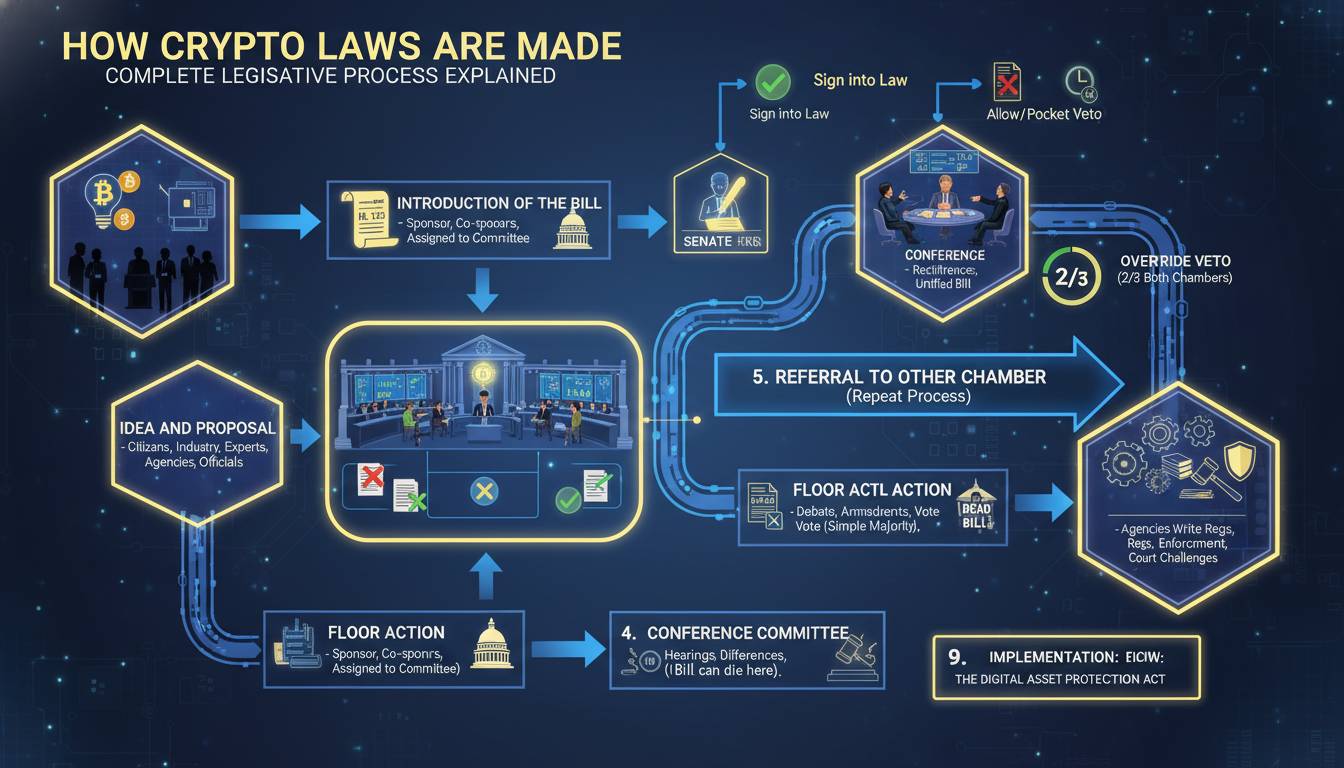
The constitutional process for making federal law applies to crypto bills just as it does to any legislation. A member of Congress introduces a bill, it gets assigned to committee, the committee holds hearings and marks up the text, the full chamber votes, the other chamber must agree, and the President signs it into law. But here’s what the explainers rarely tell you: this process takes an average of 18 months for a major bill to become law, and most bills die in committee.
For crypto specifically, the journey typically begins when industry groups identify a problem — perhaps an enforcement action that seems overreach, or a court ruling that creates legal uncertainty — and lobby Congressional offices to address it. The House Financial Services Committee and the Senate Banking Committee are the primary jurisdictions for most crypto legislation.
Here’s the actual stages.
The committee stage: Where bills live or die
A bill gets introduced and immediately lands in committee. For crypto legislation, that’s almost always the House Financial Services Committee or the Senate Banking Committee, though jurisdiction can split between multiple committees depending on the bill’s scope.
The committee chair determines whether the bill receives a hearing. Committee hearings matter enormously — they’re where Members of Congress learn about the issue, where media coverage gets generated, and where interest groups testify publicly. The 2023 House Financial Services Committee hearings on crypto regulation featured repeated clashes between SEC Chair Gensler and industry witnesses, with committee chair Patrick McHenry using the platform to build the case for comprehensive legislation.
If a bill gets a hearing, the next critical step is the markup — the committee’s line-by-line editing session where amendments get proposed, debated, and either adopted or rejected. This is where the real legislative craftsmanship happens. The FIT for the 21st Century Act, which passed the House Financial Services Committee in July 2024, went through multiple amendments addressing stablecoin provisions, SEC-CFTC jurisdictional splits, and consumer protection standards.
The committee then votes on whether to report the bill out favorably. If it passes committee, the bill goes to the full House or Senate floor.
Floor votes and the bicameral negotiation
Once a bill reaches the floor, the full chamber debates it under structured rules. The House operates under the Rules Committee, which sets debate time and determines which amendments are in order. The Senate allows unlimited debate (the filibuster), meaning a single Senator can hold up a crypto bill indefinitely unless they invoke cloture — which requires 60 votes.
This is why comprehensive crypto legislation has repeatedly stalled in the Senate despite passing the House. The Financial Innovation and Technology for the 21st Century Act passed the House in May 2024 with support from both parties, then died in the Senate without a floor vote. The politics of being the senator who killed crypto legislation are uncomfortable, so instead of voting it down, Senate leadership simply never scheduled it.
When both chambers pass different versions of a bill, a conference committee reconciles the differences. The final conference report must pass both chambers in identical form before heading to the President’s desk.
Industry’s powerful role in shaping policy
I’ll be direct: the crypto industry’s influence on the legislative process is enormous, and many articles on this topic pretend otherwise. Trade associations like the Blockchain Association, the Chamber of Digital Commerce, and the Crypto Council for Business maintain permanent lobbying operations in Washington. They draft legislative language, meet with Congressional staff weekly, and fund research that shapes the debate.
This isn’t inherently corrupt — lobbying is legal and lobbying by trade associations is a core part of how policy gets made. But readers should understand that much of the specific language in recent crypto bills was heavily influenced by industry input. The stablecoin provisions in multiple legislative proposals, for instance, were largely written to accommodate the business models of major issuers like Circle and Paxos.
Public comment periods also matter. When agencies like the SEC propose new rules, the public can submit comments. Crypto companies and their allies have submitted tens of thousands of comments on various proposals, sometimes flooding the system to create administrative burden and signal political opposition.
The industry’s power has limits, though. Despite massive spending, comprehensive crypto legislation has failed to pass multiple times. This suggests that the obstacle isn’t just opposition from consumer advocates — it’s also genuine disagreement within Congress about how to balance innovation promotion with investor protection.
The state vs. federal tension
While Congress has failed to pass comprehensive federal crypto legislation, states have been actively enacting their own rules. This creates a fragmented regulatory landscape that industry complains creates compliance nightmares.
New York’s BitLicense, established in 2014, remains the most stringent state crypto regulation — so rigorous that many companies simply stopped serving New York customers rather than comply. California passed comprehensive digital asset legislation in 2024, creating a licensing framework that takes effect in 2025. Texas, Wyoming, and Florida have all enacted crypto-friendly statutes, though the specific provisions vary significantly.
Federal preemption is the legal question that looms over this state-by-state approach. Under the Constitution’s Supremacy Clause, federal law generally overrides conflicting state law. But until Congress passes clear federal crypto legislation, courts will continue wrestling with whether existing federal statutes preempt state crypto laws. The answer remains genuinely unclear in many areas.
Recent legislation: What’s actually passed
As of early 2025, no comprehensive federal crypto legislation has become law. However, some targeted measures have advanced:
The FIT for the 21st Century Act passed the House Financial Services Committee in July 2024 and subsequently passed the full House in May 2024, marking the first time a comprehensive crypto bill cleared either chamber. The Senate never voted on it.
The Stablecoin TRUST Act, focusing specifically on payment stablecoins, has been introduced in multiple Congresses with bipartisan co-sponsorship but hasn’t reached the President’s desk.
The Financial Technology Protection Act, which would create an independent blockchain analysis unit within Treasury, has passed the House.
Executive action has partially filled the gap. President Biden’s executive order on digital assets in March 2022 directed multiple agencies to produce reports and coordinate policy, but executive orders can be reversed by the next administration and don’t carry the force of law.
What’s actually holding legislation back
Here’s the counterintuitive point that most articles miss: the main obstacle to comprehensive crypto legislation isn’t crypto-skeptic Democrats. It’s the fundamental difficulty of writing technology-neutral legislation that doesn’t become obsolete within two years. Legislators who support crypto regulation genuinely struggle with how to write rules that will still make sense when the technology evolves.
The SEC-CFTC jurisdictional question is genuinely hard. If a token functions like a security during token launch but becomes more decentralized over time, at what point does regulatory authority shift? The answer matters enormously for enforcement priorities, and reasonable people disagree.
Consumer protection advocates also have legitimate concerns that the industry sometimes dismisses too quickly. The collapse of FTX, the failure of multiple stablecoins, and the countless rug pulls that retail investors have suffered aren’t just regulatory failures — they’re evidence that some guardrails are necessary. Legislation that preempts all state regulation and strips the SEC of enforcement authority could create a regulatory void that harms the exact retail users the industry claims to want to protect.
I don’t have a neat answer to this tension. But pretending it doesn’t exist is intellectually dishonest and explains why legislation keeps failing.
The path forward: What to watch
Several trends will shape crypto legislation in the next Congress. The outcome of SEC leadership changes under the new administration will signal whether industry-focused legislation becomes more or less urgent. Court decisions — particularly the ongoing Ripple litigation and any Supreme Court rulings on SEC enforcement tactics — could effectively make law through judicial interpretation if Congress doesn’t act.
The stablecoin issue may be the most likely path to partial legislation. Both parties have expressed interest in clear stablecoin rules, and the business community (including traditional finance players entering the space) strongly supports regulatory clarity for payment stablecoins.
The process remains slow, frustrating, and deeply political. That’s not a bug in the system — it’s the system working as designed, with multiple veto points ensuring that major legislation requires broad consensus. For crypto, that consensus doesn’t yet exist.
Frequently asked questions
How long does it take for a crypto bill to become law?
The average major bill takes 18-24 months from introduction to becoming law, if it passes at all. Most bills never become law. The most recent comprehensive crypto bills have been introduced repeatedly since 2021 without reaching the President’s desk.
Can the SEC regulate crypto without new legislation?
Yes. The SEC has existing authority under securities law and has used aggressive enforcement actions to regulate crypto since 2020. However, critics argue this enforcement-by-litigation approach creates uncertainty and lacks the legitimacy that Congressional action would provide.
Why do crypto companies lobby so heavily?
Because regulatory uncertainty directly affects their ability to operate and raise capital. A clear regulatory framework reduces compliance costs and legal risk, making lobbying an investment in business viability.
Do other countries have clearer crypto laws?
Some do. The European Union’s MiCA (Markets in Crypto-Assets Regulation), which began applying in phases starting in 2024, provides the most comprehensive crypto regulatory framework globally. Many countries are watching U.S. developments closely.
What happens if Congress never passes crypto legislation?
The current regulatory fragmentation continues. Companies will face a patchwork of state regulations, aggressive (or inconsistent) federal enforcement, and ongoing legal uncertainty. This generally benefits large, well-funded companies that can afford legal teams while creating barriers for smaller entrants.
Conclusion
The legislative process for crypto isn’t broken — it’s functioning exactly as designed for contentious issues where stakeholders strongly disagree. What makes it feel different from other policy areas is the speed of technological change, the intensity of industry lobbying, and the genuine difficulty of writing future-proof legislation.
If you’re waiting for a comprehensive federal crypto law, temper your expectations. The more likely scenario involves targeted legislation on specific issues like stablecoins, continued enforcement action by existing agencies, and court decisions that partially fill the legislative vacuum. That’s not a satisfying answer, but it’s an honest one.
The question worth asking isn’t whether the system will eventually produce crypto laws — it will. The question is whether those laws will reflect thoughtful policy design or simply codify whatever regulatory framework emerged from the enforcement battles of this period. Pay attention to the markup sessions, not just the floor votes. That’s where the actual choices get made.